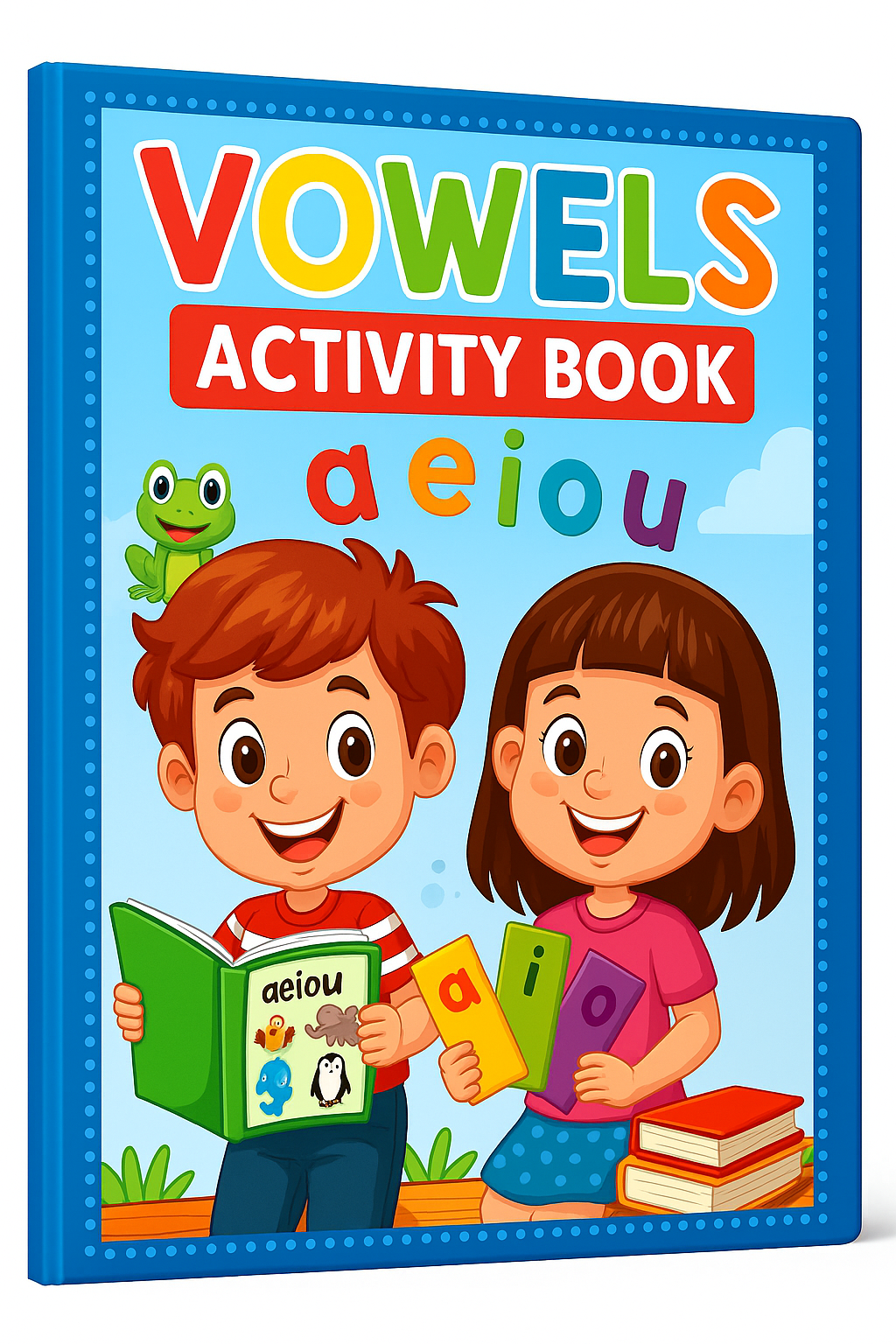
Vowels is a phonics workbook about the five vowel letters of English — a, e, i, o and u — and the sounds they make. Children practise each vowel in words, pictures and short reading tasks.
Nothing in early reading matters more than vowels: every word and every syllable contains one. This Vowels workbook gives each letter its own careful practice, short sounds first, then long.
Vowels: Learning A, E, I, O, U
Vowels teaches young children the five vowel letters: a, e, i, o and u. Every English word contains a vowel sound, so learning the vowels early gives children the base they need for reading and spelling.
Practise Vowels a little every day: say each vowel sound together, find words that use it, and let children copy the letters. The book is a free PDF on Google Drive, linked from the button below. Children can continue with Jolly Phonics Active Book CVC Reading Passages.
Use Vowels for daily phonics practice in the first years of school, or whenever a child confuses vowel sounds in reading. The download is linked from the button on this page, ready to print.
Consonants get the alphabet songs, but vowels do the heavy lifting in reading. The Vowels workbook exists because a child who owns the five vowel sounds can unlock almost any simple word in English.
Short Sounds, Then Long
Children meet a, e, i, o and u in their short forms first — cat, bed, pig, box, sun — then discover the long sounds that share the same letters. Vowels teaches the contrast directly, with sorting and reading games that make the difference audible. The trickiest vowel gets a book of its own in Exploring the Difference Between Short and Long E Sounds.
Practice on Every Page
Matching, circling, completing and reading tasks repeat each sound in new clothes, because one worksheet never built a habit. Teachers keep Vowels ready as the repair kit for the commonest reading problem in early grades.
Vowels in Daily Reading Practice
Five minutes with Vowels each morning changes a term: children start spotting vowel patterns in every book they open, and guessing gives way to reading. Parents can run the same routine at home with no preparation at all.
The five letters are few, but their sounds are many — which is exactly why a whole workbook of vowels practice earns its shelf space. Master the vowels, and English starts to open.
CopyrightsIf this website has shared your copyrighted book or your personal information.
Contact us at [email protected]
to let us know. You will receive an answer within 3 working days.
A big thank you for your understanding